Crossbow String Care: When to Wax, When to Replace
Crossbow string maintenance comes down to two cheap habits: wax the string before it dries out, and replace it before it fails. Together they take maybe twenty minutes a season — and they protect your limbs, your cams, your accuracy and your hands. Here's how often to wax, the wear signs that mean a string is done, and step-by-step video tutorials for changing strings on Ballista crossbows.
Why Crossbow String Maintenance Matters
Every shot, the string takes the full draw load and slams to a stop. The synthetic fibers themselves shrug that off — what kills them is friction, moisture, dirt and UV working on dry, unprotected strands. A neglected string goes fuzzy, bleeds speed, starts throwing fliers, and eventually lets go under full load. When that happens, it can take the serving, the cams and even the limbs with it.
Crossbow strings also live a harder life than vertical-bow strings: the center serving drags down the rail on every shot, and the string can spend a whole sit cocked. Bowfishing is harder still — water, sand and boat decks chew through strings fast. If you run your BAT on the water, our guide to addressing string breakage on bowfishing crossbows covers that abuse in detail.
The math is simple: a $9.99 stick of wax and a replacement set that starts at $39.95, against a blown hunt — or a damaged crossbow.
When to Wax a Crossbow String (and How)
The test takes five seconds. A healthy, waxed string feels smooth and slightly tacky. If it looks dry, discolored or fuzzy — wax it. Bowhunter Magazine's string-care guide recommends making that check a habit: run your fingers down the string before the first bolt goes in, every session.
As for the schedule, opinions vary more than you'd think. Wax-tube directions run as aggressive as every 5–10 shots; serious target archers re-wax every two to three weeks; most hunters do fine waxing whenever the string stops feeling tacky — plus once before opening day and after any wet sit.
Applying it right matters as much as the schedule (60X Custom Strings has a good technique walkthrough):
- Run a light bead of bowstring wax ($9.99 for a 3-pack) along the exposed strands of the string and cables.
- Work it in with your thumb and forefinger until friction melts it into the bundle. The string should come out evenly glossy, not caked.
- Wipe off the excess — leftover lumps collect dust and grit, which grinds the fibers from the inside.
One crossbow-specific warning: keep heavy wax off the center serving, the wrapped section that rides the rail and feeds the trigger box. Wax buildup there picks up grit and can gum up the trigger. Manufacturers differ on rail and serving lube, so check the manual for your model on our Manuals & Maintenance page.
7 Signs Your String Needs Replacing, Not Waxing
Wax preserves a healthy string; it doesn't resurrect a dead one. Replace the string — don't just re-wax it — when you see any of these:
- A broken or cut strand. One strand gone means the rest are carrying more than they were built for. Stop shooting.
- Fuzz that wax won't lay down. Light fuzz that smooths back into the string is normal wear. Whiskers that pop right back up are broken fibers.
- Serving separation. If the center serving slides, opens up or shows gaps, the string under it is wearing fast — and your zero is drifting with it.
- Dry, gray, chalky fibers that look thirsty again days after a fresh coat of wax.
- Kinks, flat spots or loose loop ends near the cams.
- Lost speed or wandering groups with no change to your bolts or optics — a stretched, worn string robs both.
- Age and history. The Bowhunter guide above pegs a well-maintained vertical-bow string at about three years; plan on roughly a couple of seasons of regular shooting for a hunting crossbow, less for a bowfishing rig that lives wet. And after any dry fire, inspect the string, cables, limbs and cams before the next shot — whatever the string's age.
How to Change a Crossbow String: Ballista Video Tutorials
On most hunting crossbows a string swap means a trip to the pro shop, because compound limbs need a bow press. Ballista builds around that problem — the Hawkwing's product page calls it the world's first hunting crossbow that needs no press for maintenance, and the pistol-crossbow line is just as bench-friendly. One rule before the videos: strings and cables wear together, so when one is done, replace them as a set — that's why the replacement kits come matched.
Hawkwing
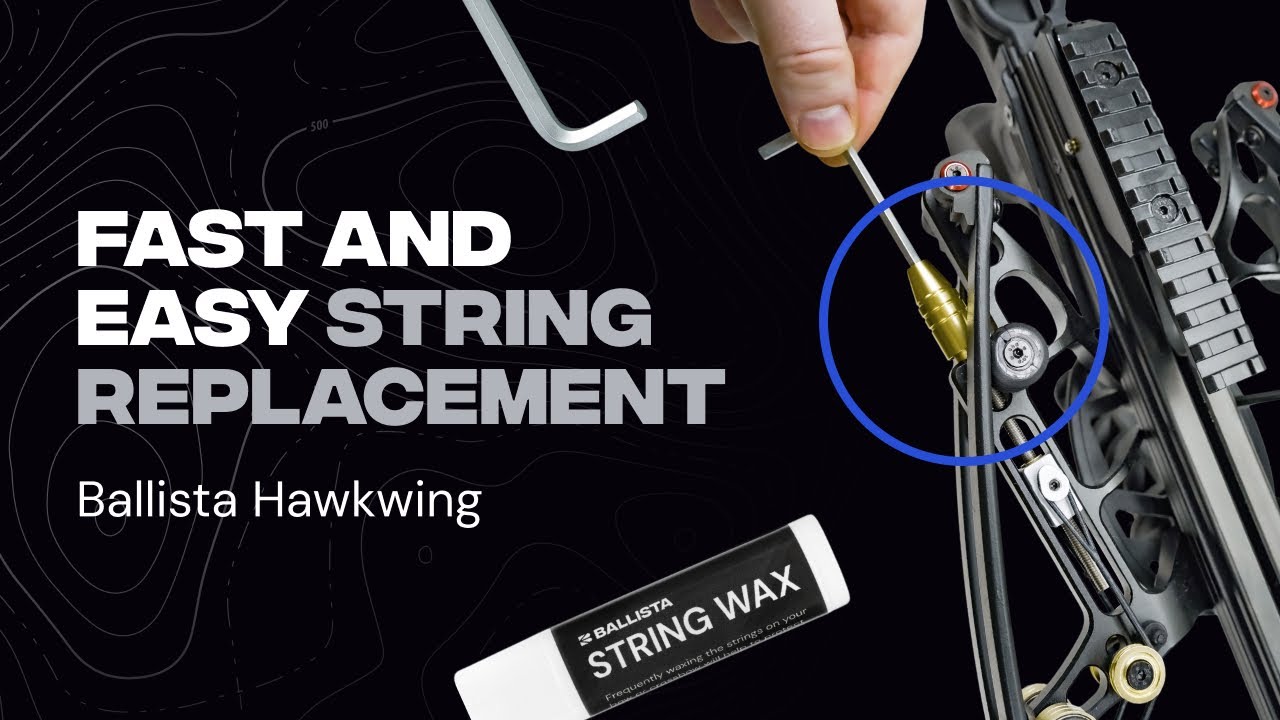
The video at the top of this page walks the full Hawkwing string change at bench pace. Prefer the short version? The team also filmed a fast and easy Hawkwing string replacement tutorial (4:41).
BAT Reverse
The full bench walkthrough below covers both the string and the cables on the BAT Reverse — worth watching once, end to end, before your first swap:
And if you're wondering whether it's really doable on a mountainside with cold fingers — here's a string changed in the field, in about two minutes:
Replacement Strings, Cables and Wax for Every Model
Match the set to your model and keep a spare in the case:
- Replacement string and cables set for the BAT — $39.95
- Replacement string and cables set for the BAT Reverse — $59.95
- Hawkwing custom string, hand-made in the USA — $70.00
- MegaBat and MegaBat Reverse sets ($79.95), plus hand-made-in-USA custom strings and full string-and-cable sets for every model, live in the Parts collection.
Crossbow String Care FAQ
How often should I wax a crossbow string?
Check it before every session: smooth and slightly tacky means it's protected; dry, fuzzy or discolored means wax it now. As a schedule, wax-stick directions say every 5–10 shots, target archers go every two to three weeks, and everyone should wax before opening day and after shooting in rain.
Can I use candle wax or lip balm on a crossbow string?
No. Paraffin and cosmetic balms dry out, flake off, and do nothing for the fiber core. Use a natural-based wax made for bowstrings — it penetrates the strands and stays tacky in hot and cold weather alike.
How long does a crossbow string last?
Plan on about two seasons of regular shooting, and less for bowfishing rigs that live wet and sandy. The calendar is only a backstop, though: one broken strand, a slipped serving or chronic fuzz and the string is done, even if it's three months old.
Should I wax the center serving?
Generally no — wax on the serving migrates into the trigger box and collects grit. Some manufacturers specify a serving or rail lube instead. Your model's manual has the final word; you'll find them all on the Manuals & Maintenance page linked above.
Give your string another season. Match a fresh string-and-cables set to your crossbow in the Ballista Parts collection, and keep a tube of wax in the case. Questions about your specific model — the FAQ and support team have you covered.