Crossbow Quiver Buying Guide: Fit and Features for 2026
Choose a crossbow quiver that fits your arrows, mounting rail, and carrying routine. Learn what to check before buying and which details matter most.
Video: a closer look at the BALLISTA four-arrow quiver. Check the current listing and your exact crossbow configuration before ordering.
A quiver is easy to leave until the end of a shopping list. You have chosen the crossbow, figured out which arrows it requires, and found a case. Then one small question holds everything up: where will the spare arrows go?
The answer should be simple. Your arrows need a suitable place to travel, their points need protection, and the carrier needs to fit the rest of your gear. A good purchase starts with those details, not the biggest capacity or the word “universal” on the box.
Crossbow quiver compatibility: check three separate things
Before comparing prices, write down your crossbow model and configuration, the outside diameter of your arrow shafts, and the exact points or broadheads you use. These answer three different compatibility questions. One “yes” does not cover all three.
Does it hold your arrows?
The shaft grippers need to suit the arrows you actually own. Do not assume that all crossbow bolts have the same diameter, or that a holder for standard shafts also supports a smaller shaft. Use the arrow manufacturer's published specifications when available.
There is another distinction worth keeping clear: quiver compatibility is not shooting compatibility. An arrow that fits the carrier is not automatically approved for your crossbow. For arrow selection, start with the crossbow manual; our bolts and broadheads guide provides additional buying context.
Does the hood suit your points?
A shaft can fit while its broadhead does not. Ask about your exact point design, especially if the description says “most broadheads.” That wording leaves room for exceptions. Do not force a sharp head into an unsuitable insert or improvise a way to keep an exposed blade in place.
The Wisconsin DNR's archery safety guidance recommends a covered quiver to protect both the user and arrow points. Treat coverage as a basic requirement, not an optional comfort feature.
Does the mount fit your setup?
A rail-mount accessory needs the appropriate usable rail in the right location. A product photo showing a complete setup does not establish which mounting parts come with your particular package. Confirm the attachment standard, required hardware, and anything sold separately.
If you own a BAT Reverse or are considering a Hawkwing, give support the exact configuration rather than only the family name. Include a clear photo of the intended mounting area. That is more useful than trying to settle fitment from a distant image.
Quick-detach quivers: think about the whole trip
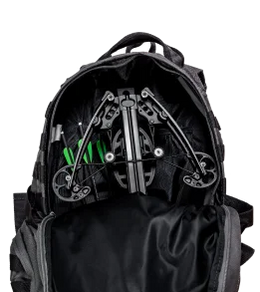
Quick-detach hardware is useful when your routine includes removing the quiver for a case or storing it separately. Before buying, picture the ordinary transitions: packing at home, carrying your gear, setting it down, and packing again. Where will the detached quiver go each time?
Check the case as part of that decision. Measure available space and consult the case and quiver specifications; a case that fits the bare crossbow may not accommodate every accessory arrangement. Do not plan on squeezing a loaded quiver against other gear to make the zipper close.
A hanging loop can be convenient, but it does not turn a quiver into a general-purpose hook or lifting handle. Follow the product instructions and keep sharp points protected wherever you place it. For a broader packing list, see our crossbow hunting gear checklist.
Four arrows or more: choose capacity for your routine
More slots are not automatically better. Think about how many arrows you need to carry together and how you will transport any extras. A short range visit and a longer trip may call for different packing arrangements, even with the same crossbow.
A practical test on paper is to list everything that must fit in your case or bag. If you already have suitable protected storage for spare arrows, a larger attached carrier may solve a problem you do not have. If you regularly need more capacity, compare suitable carriers rather than overcrowding a smaller one.
The BALLISTA crossbow quiver: published specifications
The BALLISTA Crossbow Quiver lists four-arrow capacity, a 5.5–8.8 mm shaft-diameter range, and a quick-detach 20 mm Picatinny mount. It also has a non-collapsing hanging loop and a foam insert described as suitable for most broadheads.
Those details provide a starting point for fitment, not a guarantee for every combination. Match your actual arrows, heads, and mounting arrangement before ordering. The listed price was $49.95 on October 13, 2026; check the product page for current price and availability.
Questions to ask before you order
- Will this quiver retain my exact arrow shaft diameter?
- Is the hood and insert suitable for my point or broadhead model?
- Does my crossbow configuration have the required mounting provision?
- Which mounting parts are included, and which must I buy separately?
- Will my case accommodate the intended carrying arrangement?
If one answer is unclear, contact BALLISTA before checkout. A short fitment question is easier to resolve than an accessory that arrives without the hardware your setup needs.
Crossbow quiver FAQ
Does “universal” mean it fits every crossbow?
No. Read the stated interface and size limits, then confirm the complete arrangement. Broad compatibility still has conditions.
Can one quiver hold different shaft diameters?
Some can, within their published range. Check each arrow you intend to carry; do not infer compatibility from how another arrow fits.
Can I use a quiver instead of a case?
A quiver carries arrows; it does not protect the entire crossbow. Choose transport equipment for each item and follow its manufacturer's instructions.
Start with confirmed fit, then choose the carrying features you will actually use. You can browse BALLISTA accessories once those details are settled.